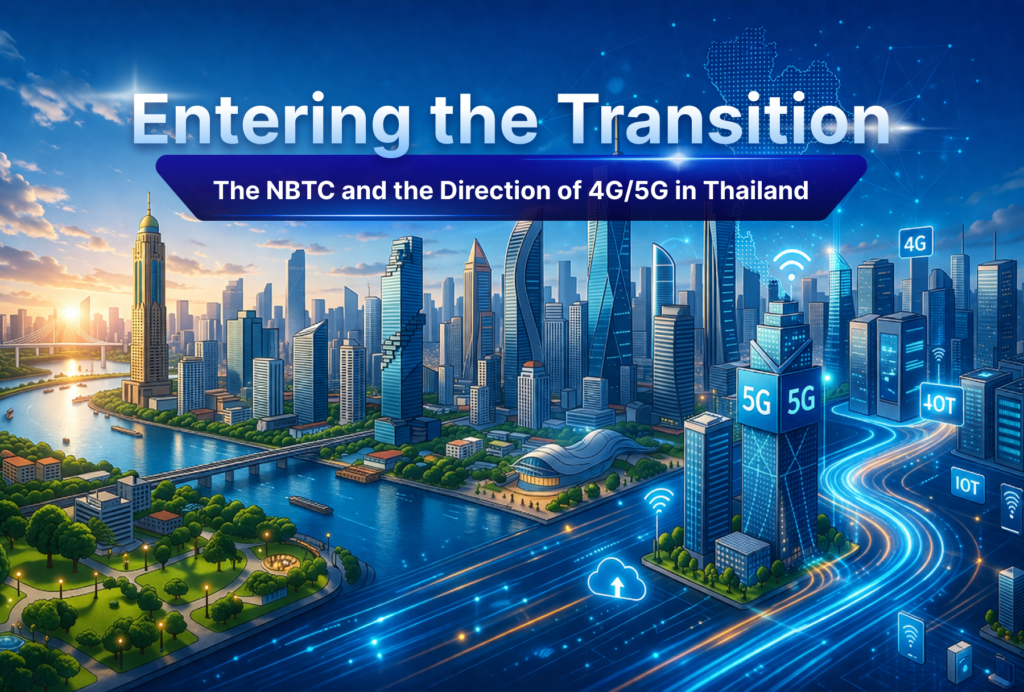
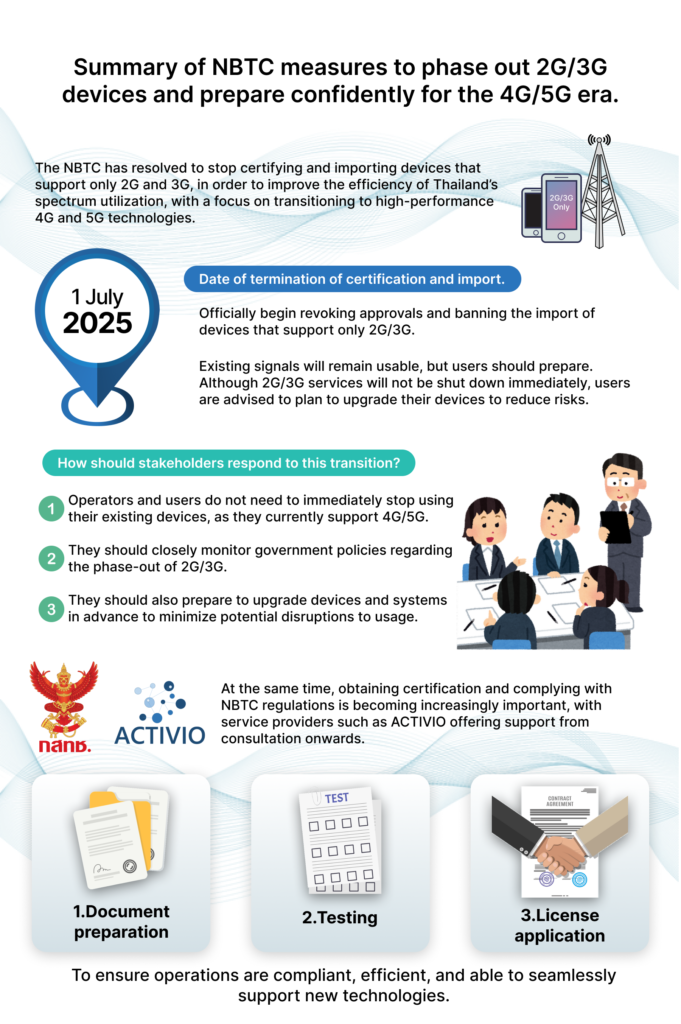
On June 30, 2025, the National Broadcasting and Telecommunications Commission (NBTC), which plays a key role in regulating the country’s communications systems, approved ending the authorization for importation and type-approval certification of telecommunications devices and equipment that support only 2G and 3G.
The decision stems from the fact that current mobile devices support 4G and 5G, which outperform older generations in many dimensions — including higher peak data rates, greater connection density, etc. — and that service coverage already reaches most of the country.
To make spectrum use more efficient, the NBTC has set the following measures:
1.Cancel new approvals for devices that support only 2G and 3G effective July 1, 2025. Type approval will still be allowed for multi‑mode devices that support 4G/5G.
2.Officially ban the importation of devices that support only 2G/3G starting July 1, 2025.
However, although importation and type‑approval of such devices will cease, 2G and 3G signals will continue to be in use; no definitive shutdown date for those services has been set immediately, so users and operators can continue using the existing networks for now.
However, although importation and type‑approval of such devices will cease, 2G and 3G signals will continue to be in use; no definitive shutdown date for those services has been set immediately, so users and operators can continue using the existing networks for now.
How should stakeholders respond to these changes?
Currently, devices used in both daily life and industrial sectors are largely multi-mode, supporting 4G/5G connectivity by default. These technologies are also more accessible than in the past, so there is no immediate need to discontinue usage right away.
However, based on the government’s policy direction to phase out 2G and 3G networks in the long term, operators and users should closely monitor updates and announcements from the NBTC (National Broadcasting and Telecommunications Commission). This will help ensure timely preparation for upgrading equipment and systems to comply with potential future regulations, as well as minimize risks to operations and service continuity.
In this context, preparing for equipment certification and regulatory compliance becomes increasingly important. ACTIVIO is ready to provide comprehensive support for NBTC certification processes, covering everything from consultation and application submission to coordination for testing and licensing procedures, including:
In this context, preparing for equipment certification and regulatory compliance becomes increasingly important. ACTIVIO is ready to provide comprehensive support for NBTC certification processes, covering everything from consultation and application submission to coordination for testing and licensing procedures, including:
-Assisting with submission of certification applications to the NBTC
-Reviewing and preparing required documentation
-Arranging testing facilities and conducting tests
-Supporting applications for related licenses
-This enables operators to proceed accurately, efficiently, and in full compliance with government requirements—an essential factor in ensuring a smooth and sustainable transition to next-generation communication technologies.
This enables operators to proceed accurately, efficiently, and in full compliance with government requirements—an essential factor in ensuring a smooth and sustainable transition to next-generation communication technologies.
References: Official Announcements
1.Notification on the discontinuation of importation, inspection, and certification of telecommunications equipment supporting only 2G and 3G technologies, issued by the Office of the National Broadcasting and Telecommunications Commission (NBTC)
2.Minutes of the NBTC Board Meeting No. 11/2025 (continued), Office of the National Broadcasting and Telecommunications Commission (NBTC)
Related News
3.NBTC seeks AIS, True plans to end 2G, 3G
4.NBTC wants AIS, True to provide roadmap for 2G/3G shutdown – Developing Telecoms